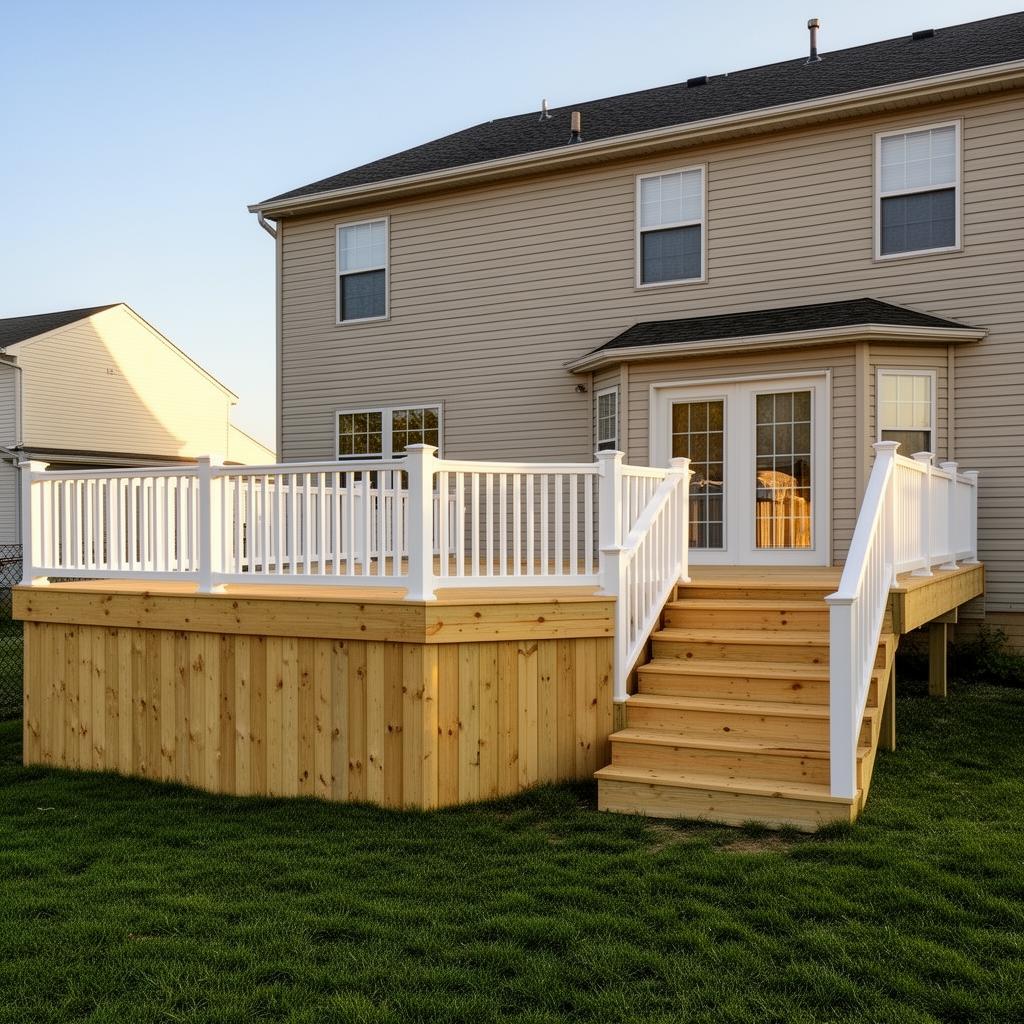
Pressure-treated southern yellow pine is the most common decking material on wood deck builds across the South for a reason: it is rot-resistant, locally produced, well-priced, and accepts stain in any color you want. Done with the right framing and the right hardware, a pressure-treated deck delivers two decades of service at a fraction of cedar's cost. The difference between a fifteen-year deck and a twenty-five-year deck is in how the framing was put together, not in the lumber on top.
Ground-Contact-Rated Framing on Every Joist
Framing decisions matter more on pressure-treated than on any other material. Contractors in our network use ground-contact-rated lumber on every joist and beam — the rating that handles soil, concrete contact, and trapped moisture — even though the cheaper above-ground rating would technically be allowed on some pieces. The cost difference is small and the life difference is significant, so it is not a homeowner decision on our jobs.
We pay for the better lumber so you do not have to call us back in twelve years.
Galvanized and Stainless Hardware Only on PT Decks
Hardware on pressure-treated has to be hot-dipped galvanized at minimum, stainless on the surface fasteners — the same standard we apply on every new deck installation regardless of species. The copper-based preservative in modern pressure-treated lumber will eat anything less. We do not stock bright-finish or interior-grade hardware on the truck, and we will not patch a job that was built with it.
Cheap fasteners on pressure-treated are a slow-motion failure that shows up at year five as ledger pull-away or rail drop. By then it is your problem, not the original installer's.
Copper or Galvanized Z-Flashing — Never Aluminum
Flashing is the third detail we do not compromise on. Aluminum z-flashing is incompatible with pressure-treated lumber — the copper in the treatment and the aluminum in the flashing form a galvanic cell that corrodes the flashing within a decade. The local contractors we work with use copper or galvanized steel z-flashing exclusively, and we flash every house-side ledger before a single joist goes up.
If you ever pull a deck off a house and find white powder where the flashing used to be, you are looking at the aftermath of aluminum-on-PT chemistry.
End-Cut Preservative on Every Field Cut
Field cuts get sealed. Every saw cut on pressure-treated lumber exposes untreated wood at the cut face, and that face is where rot starts. We treat every field cut with copper naphthenate end-cut preservative as part of the build.
It is a small step that takes a few minutes per cut, and it is the difference between a deck where the cut ends rot out at year ten and one where they last as long as the rest of the lumber. Most crews do not bother. We do.
When You Can Stain a New Pressure-Treated Deck
Stain timing is the part homeowners across Alpharetta hear about most after the deck is done. Pressure-treated lumber comes off the truck wet from the treatment process, and it needs four to eight weeks of dry-down time before it will accept stain. Staining wet lumber produces blotchy color that has to be sanded off and redone.
We hand off a one-page stain prep guide on every job that explains the timing, the water-bead test, and the products that work in our climate.
Hands-On Experience With Pressure Treated Deck Installation
A contractor in our network rebuilt a deck on a Dunwoody property a couple of summers back where the original installer had used aluminum z-flashing against the pressure-treated ledger. The aluminum had corroded into a powdery white deposit and the ledger had begun pulling away from the house. A contractor in our network replaced with copper z-flashing, structural-screw-attached the ledger, and reframed the section of the deck that had begun shifting.
That job is exactly why we do not stock aluminum flashing on the truck — vetted contractors in our network use copper or galvanized steel against pressure-treated, every time, no exceptions.
Craftsmanship & Quality Standards
The craft on pressure-treated is mostly about respecting the chemistry. The copper in the treatment is corrosive to the wrong metals. Field cuts expose untreated wood.
The lumber comes wet and needs to dry before stain. None of those facts are exotic, and all of them are the difference between a deck that stands for two decades and one that fails at five years. Local pros in our network build that knowledge into every step of the install — the lumber we order, the hardware we stock, the sealing we do at field cuts, and the guide we hand you at close-out.
Why Homeowners Choose Our Pressure Treated Deck Installation
Ground-contact-rated framing
UC4A treatment on all structural lumber.
Compatible flashing only
Copper or galvanized steel z-flashing — never aluminum.
Stain prep guide included
One-page handout on dry-down timing and product selection.
Hot-dipped galvanized fasteners
Structural screws on framing, ring-shank on decking.
Permitted and inspected
Building permit pulled and framing inspected on every build.
How We Install Your Pressure Treated Deck Installation
- 1
Permit and footings
Permit pulled, footings poured below frost line.
- 2
Framing
UC4A pressure-treated joists and beams, Simpson hangers.
- 3
Ledger flashing and attachment
Copper z-flashing, structural screws, code-rated spacing.
- 4
Decking surface
Pressure-treated 5/4 radius-edge decking, hot-dipped or stainless fasteners.
- 5
Railings, stairs, walk-through
Code-compliant rail height, baluster spacing, stair rise/run.
Licensing, Insurance & Credentials
All of our contractors are licensed and insured, NADRA members, and have been building pressure-treated decks since 2020.
Pressure Treated Deck Installation Questions, Answered
Is pressure-treated safe for kids and pets?
Yes. The current MCA and ACQ treatments are EPA-registered for residential use, including decks and play structures. The pre-2003 CCA-treated lumber is the one that was phased out.
How long should I wait to stain a new pressure-treated deck?
4 to 8 weeks. Test by sprinkling water on the boards — if it beads up, the lumber is still too wet. If it absorbs, the deck is ready to stain.
What stain works best?
Penetrating semi-transparent stains from Penofin, Cabot, and Sherwin-Williams Deckscapes have worked best for us in this climate. Solid-color stains film-form and peel over time. We recommend semi-transparent.
Do I need to seal the cut ends?
Yes — every cut exposes untreated wood. We treat all field cuts with copper naphthenate end-cut preservative as part of our build process.
How long will a pressure-treated deck last?
18 to 22 years on the framing, 15 to 20 years on the surface decking with reasonable stain maintenance. Some last longer; some shorter depending on shade, drainage, and maintenance.