
Sandy Springs enforces pool-enclosure code as strictly as any city in north metro Atlanta. If you are scheduling a fence installation around a new or existing pool, the fence contractor you hire is the difference between a single-walk inspection and a re-inspection that delays your final certificate of occupancy by a week. This is what the network actually specs on every Sandy Springs pool fence — and the hardware mistakes that cost a re-inspection.
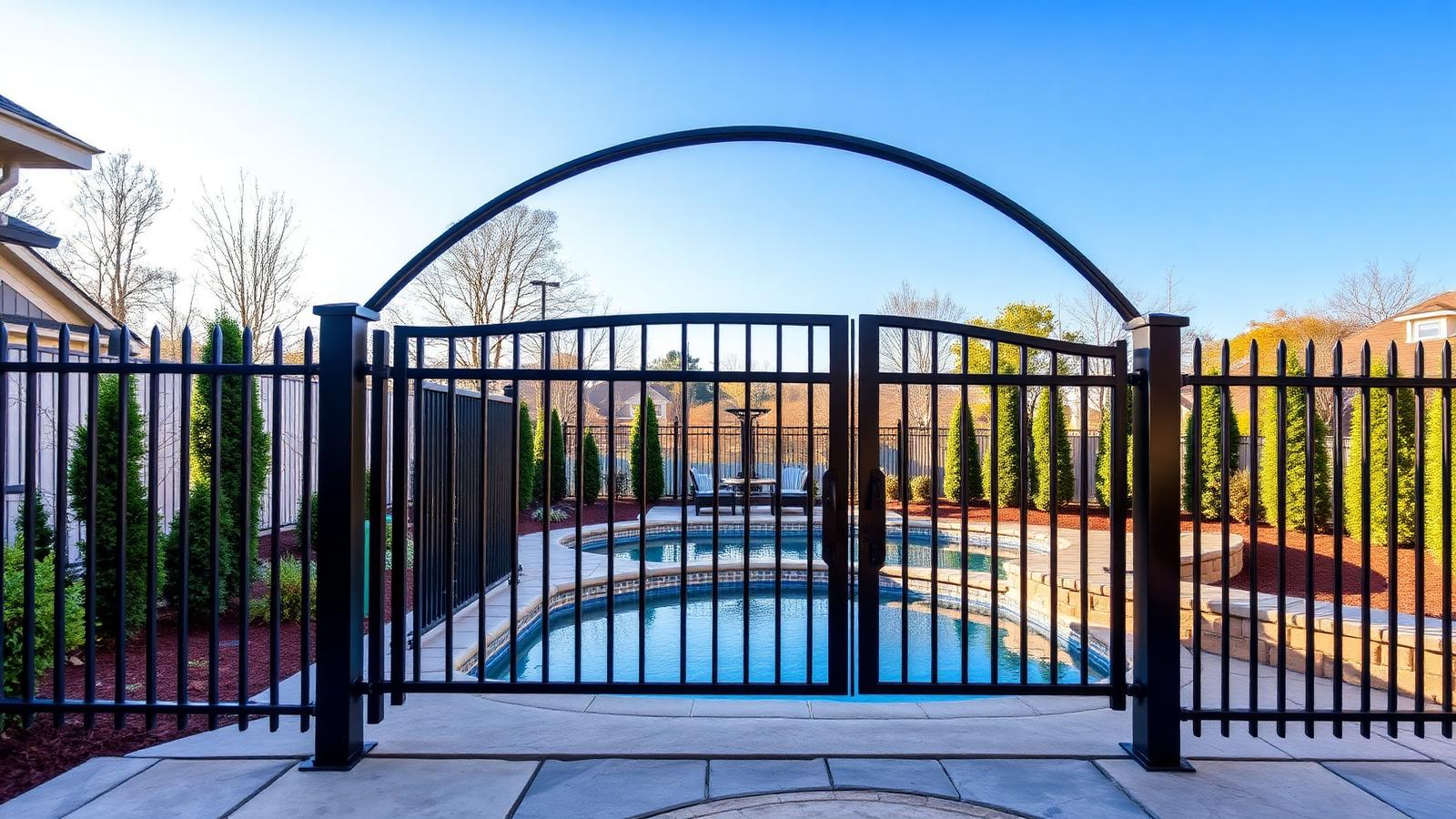
The 48-inch rule and why a Sandy Springs fence contractor checks it twice
Pool-enclosure fence in Sandy Springs must be a minimum of 48 inches tall, measured from the outside finished grade to the top of the fence — not from the pool deck. This trips up homeowners who measure from the pool side of a sloped lot. Every aluminum fence installation the network does on a Sandy Springs pool starts with a grade check at every post location, and we adjust panel height and post depth to keep the lowest exterior grade point at or above 48 inches.
The 4-inch picket gap — and why budget aluminum fails it
Vertical picket spacing on a Sandy Springs pool fence cannot exceed 4 inches at any point. Sounds simple. The trap is that a number of budget aluminum fence panels are sold in 6-foot-wide sections with picket spacing that drifts wider on the end picket-to-post gap, especially when the post is plumbed slightly off.
A fence contractor doing pool work has to know which manufacturer's panels actually hold the 4-inch spec end-to-end. Jerith and Ameristar pressed-spear panels are the two the network specs on every Sandy Springs pool job for exactly this reason — both manufacturers hold the 4-inch maximum across the full panel width and at the post junction.
Self-closing, self-latching gates — the hardware mistakes
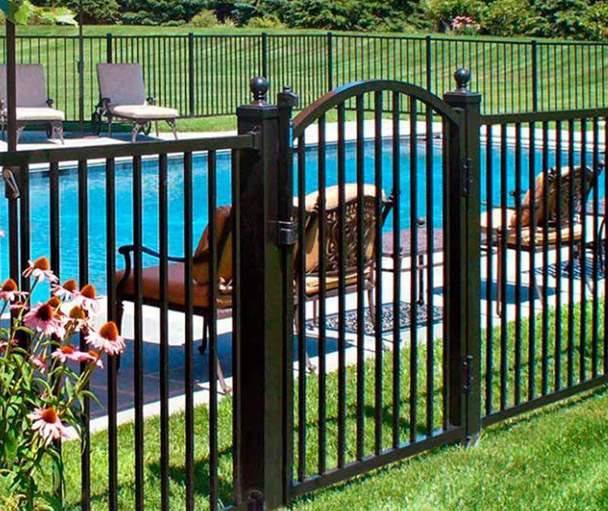
Every gate in the pool enclosure must be self-closing and self-latching, with the latch a minimum of 54 inches above grade on the outside, and the gate must swing outward (away from the pool). Self-closing means a hinge that pulls the gate fully shut from any open position — most often a Tru-Close or D&D MagnaLatch hinge with proper tension. The hardware mistakes that fail Sandy Springs inspection are: a residential-grade spring hinge that does not close from a 90-degree open position; a magnetic latch installed at 48 inches instead of 54; a gate hung on the wrong side and swinging toward the pool.
Every Sandy Springs pool gate installation the network does uses MagnaLatch series 3 latches and Tru-Close heavy-duty hinges, set to factory spec — that is what passes.
The driveway gate exception
If the pool enclosure runs along a driveway with an automated gate, that gate has its own code: UL-325 compliant operator with a photo-eye safety beam at 6 inches above grade, redundant entrapment protection, and a manual-release mechanism. The driveway gate also has to self-close (the operator handles this) and self-latch (electric strike or magnetic lock). A Sandy Springs fence contractor doing pool work needs to know UL-325 — the inspector will check it.
Wood and vinyl as pool fence — when they work and when they don't
Code does not require aluminum for a pool enclosure. A wood privacy fence installation or a vinyl privacy fence at 48-plus inches with the right gate hardware passes inspection. The reason 90 percent of Sandy Springs pool fence is aluminum is sight line — homeowners want to see the pool from the house.
If sight line is not a priority and you want full privacy, wood and vinyl are valid choices. The fence contractor still has to handle the gate hardware the same way — self-closing, self-latching, latch at 54 inches, swings outward.
What a free Sandy Springs fence installation estimate covers
Every Sandy Springs pool fence installation estimate the network writes includes the grade check, the panel manufacturer and grade, the gate count and hardware spec, the city permit (every pool fence in Sandy Springs requires a permit regardless of height), and the inspection schedule. Free, on-site, written. No high-pressure close.
If you are getting estimates from anyone who is not putting the gate hardware spec on the quote in writing, get a second opinion from a fence contractor who will. We also handle Sandy Springs stream-buffer setbacks where applicable.
Frequently Asked Questions
Does Sandy Springs require a permit for a pool fence?
Yes. Every pool-enclosure fence in Sandy Springs requires a building permit and a final inspection regardless of height. The fence contractor we match you with pulls the permit and schedules the inspection as part of the fence installation.
Can I use my existing 6-foot wood privacy fence as the pool enclosure?
If it is at least 48 inches at the lowest exterior grade point, has gates that self-close and self-latch with the latch at 54 inches, and swings outward, yes. Most existing wood fences fail on the gate hardware. A fence contractor can usually retrofit the hardware without rebuilding the fence.
What does pool fence installation cost in Sandy Springs?
It varies by linear footage, gate count, and panel grade. Most residential pool enclosures run from the mid-thousands to the low five figures. Estate-scale enclosures with multiple gates and an automated driveway gate run higher. Every estimate is free, on-site, and written.